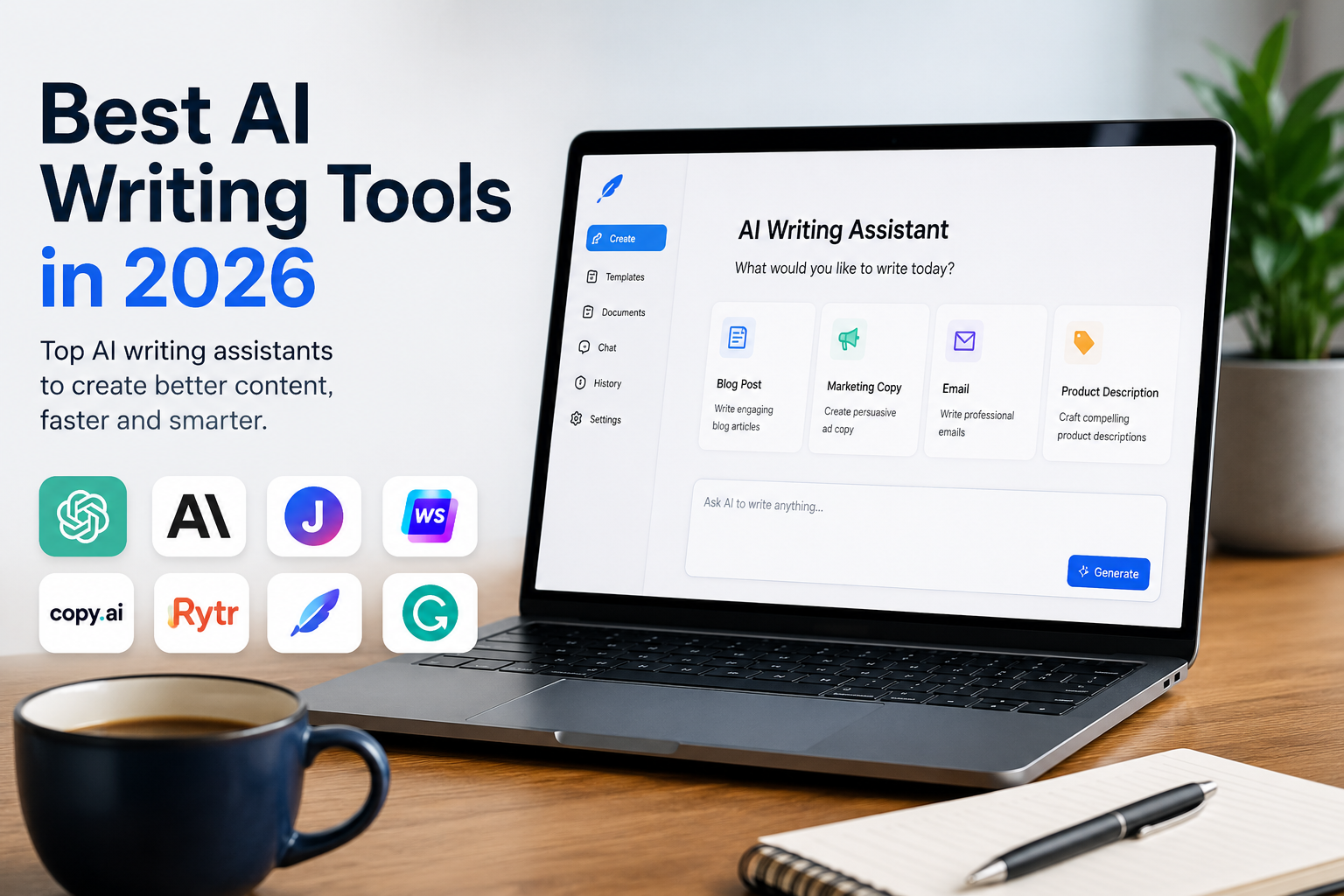
If you've ever struggled to write blog posts, marketing emails, social media content, or product documentation, you're not alone. I know how time-consuming creating quality content can be, especially for SaaS founders, marketers, and small business owners wearing multiple hats. Fortunately, AI writing tools have become smarter, faster, and more reliable than ever before. In this guide, we'll explore the best AI writing tools in 2026, what makes each one unique, and how to choose the right option for your workflow. Whether you're creating SEO articles or customer support content, there's an AI assistant designed to help.
Which AI Writing Tool Is the Best Overall?
The best AI writing tool depends on individual needs, but ChatGPT remains one of the strongest all-around options in 2026. It supports long-form writing, brainstorming, editing, coding, research, and content planning. Its flexibility makes it suitable for freelancers, SaaS founders, and marketing teams alike.
Other leading tools include Claude, Jasper, Copy.ai, Writesonic, and Rytr. Each focuses on different strengths, such as marketing copy, SEO optimization, or business content. Choosing the right platform depends on writing goals, budget, and preferred workflow rather than popularity alone.
When comparing AI writing software, users should evaluate writing quality, ease of use, integrations, collaboration features, and pricing. Many professionals also combine multiple AI writing tools instead of relying on a single platform for every content task.
How Do AI Writing Tools Improve Content Creation?
AI writing tools reduce the time needed to create high-quality content. They help generate outlines, improve grammar, rewrite sentences, summarize information, and suggest better wording. This allows writers to spend more time refining ideas instead of staring at blank pages.
Businesses also use AI to maintain consistent messaging across blogs, emails, product pages, and social media. Instead of creating every piece from scratch, teams can quickly produce first drafts that require only light editing before publication.
For SaaS companies, AI writing assistants speed up documentation, onboarding guides, customer support articles, and feature announcements. They also simplify content repurposing by turning blog posts into newsletters, LinkedIn posts, or marketing emails without repeating manual work.
What Features Should You Look for in an AI Writing Tool?
Writing quality should always be the first consideration. The best AI tools produce natural, readable content instead of robotic paragraphs filled with repetitive phrases. Good editing capabilities are equally important because every AI-generated draft benefits from human review.
SEO features have become increasingly valuable. Many AI writing platforms now recommend keywords, optimize headings, improve readability, and structure content for search engines. This makes them particularly useful for businesses investing in content marketing.
Integration with other software also matters. Popular AI writing tools connect with Google Docs, Microsoft Word, Notion, WordPress, and project management platforms. These integrations reduce workflow interruptions and make publishing content much faster for busy teams.
Which AI Writing Tool Is Best for SEO Content?
Writers focused on organic traffic often prefer tools like Jasper, Writesonic, and Surfer AI because they combine AI writing with SEO recommendations. These platforms help structure articles around search intent while improving keyword placement and readability.
SEO writing tools also analyze competing pages, suggest semantic keywords, and identify missing topics that improve content completeness. This supports both traditional search engine optimization and Answer Engine Optimization as AI-powered search continues growing.
When selecting software, SaaS founders should prioritize collaboration, brand voice customization, API availability, and workflow automation. Businesses looking to strengthen customer communication should also read how Small Businesses Can Manage Customer Relationships More Effectively, as effective CRM practices work alongside AI writing tools to create better customer experiences and long-term growth.
Are Free AI Writing Tools Good Enough?
Many free AI writing tools are surprisingly capable for occasional users. ChatGPT's free version, Google Gemini, and Microsoft Copilot allow users to draft articles, brainstorm ideas, rewrite paragraphs, and answer questions without paying for a subscription.
Free plans usually include message limits, fewer advanced features, and access to smaller AI models. Businesses publishing large volumes of content often benefit from premium subscriptions that provide higher limits, better reasoning, and faster performance.
Before upgrading, users should identify their actual needs. Someone writing one blog each week may never need enterprise features, while agencies producing dozens of articles monthly often save significant time with paid AI writing software.
Can AI Writing Tools Replace Human Writers?
AI writing tools can generate impressive first drafts, but they cannot fully replace experienced human writers. They still make factual mistakes, misunderstand context, and occasionally produce repetitive or generic content without careful prompting and editing.
Human writers contribute creativity, emotional understanding, storytelling, industry expertise, and strategic thinking. These qualities help businesses create content that builds trust with readers rather than simply filling pages with words.
The most successful content teams combine AI and human expertise. AI handles repetitive writing tasks while people focus on research, originality, brand voice, and final quality control. This partnership delivers better results than either working alone.
Which AI Writing Tool Is Best for SaaS Companies?
SaaS companies often require more than simple blog writing. They create onboarding guides, knowledge bases, release notes, email campaigns, product documentation, landing pages, and customer support articles. Versatile AI writing tools simplify all these content needs.
ChatGPT and Claude excel at technical explanations and documentation, while Jasper and Copy.ai offer strong marketing templates. Businesses may also explore internal linking opportunities by connecting articles about SaaS marketing, customer acquisition, or product launches.
When selecting software, SaaS founders should prioritize collaboration, brand voice customization, API availability, and workflow automation. These features improve consistency as content operations grow alongside the business.
What Are the Limitations of AI Writing Tools?
AI writing tools rely on patterns learned from large datasets rather than genuine understanding. As a result, they sometimes generate inaccurate information, outdated advice, or confident statements that require verification before publication.
Another limitation involves originality. While AI creates unique combinations of words, different users may receive similar responses for identical prompts. Careful editing helps ensure content reflects a company's expertise and maintains a distinctive voice.
Privacy is another consideration. Businesses handling confidential information should review data policies before entering sensitive customer information, financial records, or proprietary business strategies into any AI writing platform.
How Can You Get Better Results from AI Writing Tools?
Better prompts usually produce better content. Providing clear instructions about audience, tone, word count, goals, and formatting significantly improves output quality. Detailed prompts reduce unnecessary revisions and help AI understand the intended outcome.
Editing remains essential after generation. Users should verify facts, improve transitions, personalize examples, and ensure the content matches their brand voice. AI performs best when treated as a collaborative assistant instead of an automatic publisher.
Many professionals also experiment with multiple prompts before choosing the strongest draft. Refining instructions, requesting rewrites, and asking AI to explain its reasoning often lead to clearer, more valuable content for readers.
Should You Invest in an AI Writing Tool in 2026?
For most businesses, investing in AI writing software provides strong value through faster content creation and increased productivity. Marketing teams can publish more consistently while maintaining quality standards with proper human editing.
The return on investment becomes even greater for SaaS startups, agencies, and content-focused businesses producing articles, newsletters, documentation, and customer communications regularly. Time savings often outweigh subscription costs within just a few months.
Choosing the right AI writing tool depends on business goals rather than feature lists alone. Testing several platforms through free trials helps identify which solution fits existing workflows, content requirements, and long-term growth plans.
In Summary
AI writing tools have become essential productivity partners for founders, marketers, freelancers, and growing businesses in 2026. They help create better content faster while reducing repetitive writing tasks. However, the best results still come from combining AI efficiency with human creativity, expertise, and careful editing. Whether the goal is publishing SEO articles, writing marketing copy, producing product documentation, or improving customer communication, the right AI writing tool can save valuable time and improve consistency. By selecting software that matches specific business needs, users can build a faster, smarter, and more effective content creation process.
Frequently Asked Questions
1. What is the best AI writing tool in 2026?
The best AI writing tool depends on individual needs. ChatGPT is ideal for versatile writing, research, and editing, while Jasper excels in marketing copy. Claude is excellent for long-form content, and Writesonic offers strong SEO features. Testing free versions helps determine which platform best matches specific workflows and content goals.
2. Can AI writing tools create SEO-friendly blog posts?
Yes. Many AI writing tools generate SEO-friendly articles by suggesting keywords, improving readability, organizing headings, and matching search intent. However, human editing remains essential to verify facts, add unique insights, optimize internal links, and ensure the content reflects a consistent brand voice before publishing.
3. Are AI writing tools suitable for small businesses?
Absolutely. Small businesses can use AI writing tools to create blogs, email campaigns, product descriptions, customer support articles, and social media content more efficiently. They reduce writing time, improve consistency, and help businesses publish quality content regularly without hiring a large content team.
4. Do AI writing tools replace human writers?
No. AI writing tools assist writers rather than replace them. They generate drafts quickly, but human writers provide creativity, storytelling, industry knowledge, and accuracy. The best results come from combining AI-generated content with careful editing, fact-checking, and personalization before publication.
5. Which AI writing tool is best for SaaS companies?
SaaS companies often benefit from ChatGPT, Claude, Jasper, and Copy.ai. These tools help create product documentation, landing pages, onboarding guides, knowledge base articles, and marketing content. The ideal choice depends on business size, collaboration needs, content volume, and preferred integrations with existing software.
6. Are free AI writing tools worth using?
Yes. Free AI writing tools are excellent for brainstorming, drafting articles, rewriting text, and generating ideas. However, paid versions usually offer faster responses, more advanced AI models, larger usage limits, and additional features that benefit businesses producing content regularly throughout the year.
7. How accurate are AI writing tools?
Modern AI writing tools are highly capable but not perfect. They occasionally produce incorrect facts, outdated information, or misleading statements. Every article should be reviewed carefully before publication to ensure accuracy, maintain credibility, and deliver valuable information that readers can trust confidently.
8. Can AI writing tools help with email marketing?
Yes. AI writing tools generate promotional emails, newsletters, welcome sequences, follow-up messages, and personalized campaigns. They also improve subject lines, rewrite copy for better engagement, and save marketers significant time while maintaining consistent messaging across multiple email marketing campaigns.
9. What features should I look for in an AI writing tool?
Important features include writing quality, grammar checking, SEO optimization, collaboration tools, document organization, integrations, multilingual support, and customization options. Businesses should also compare pricing, ease of use, security policies, and customer support before choosing an AI writing platform.
10. Should I invest in a paid AI writing tool?
If content creation is a regular part of business operations, investing in a paid AI writing tool is often worthwhile. Premium plans improve productivity, support higher-quality outputs, and offer advanced capabilities that help marketers, founders, and content teams produce more consistent results while saving valuable time.